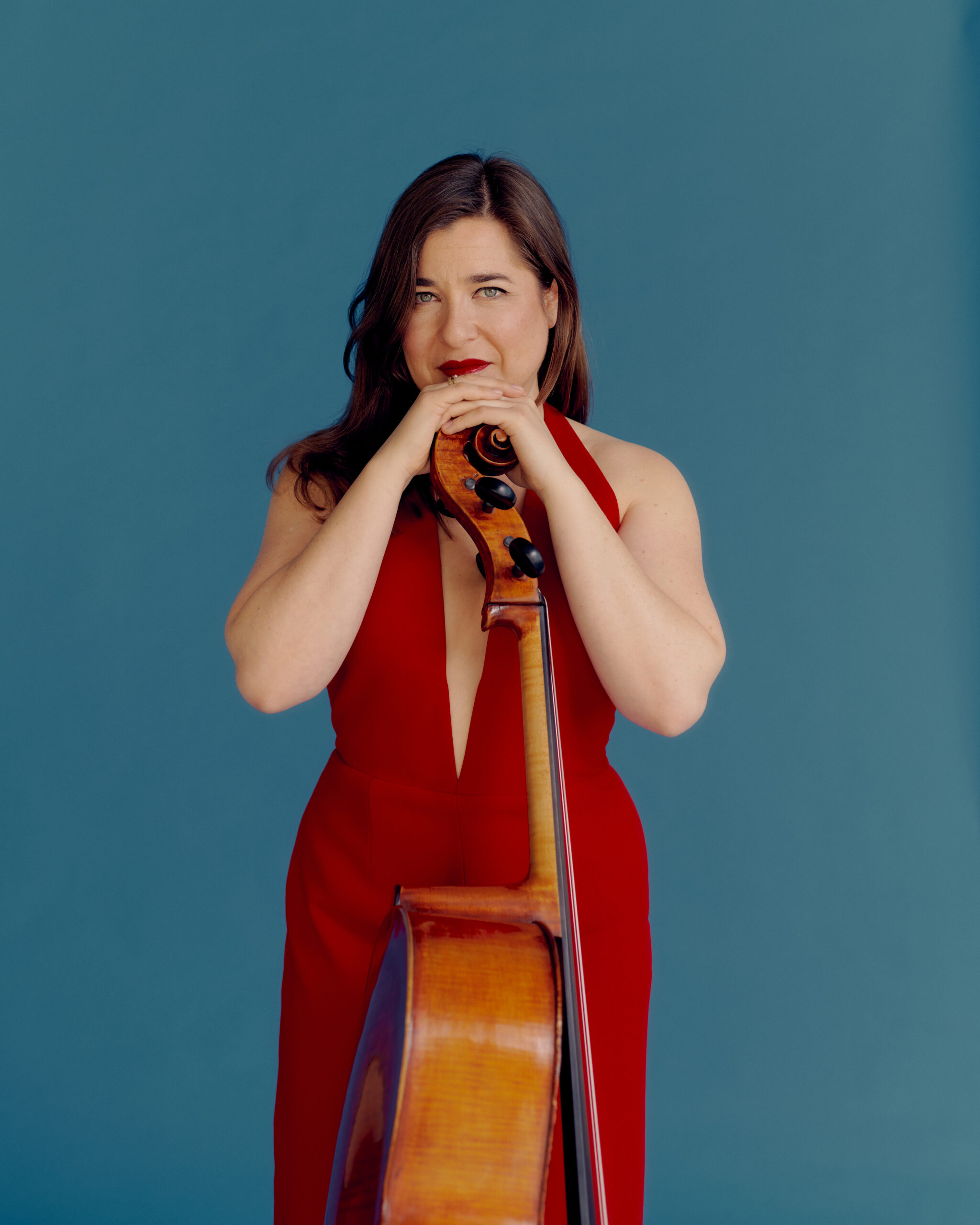
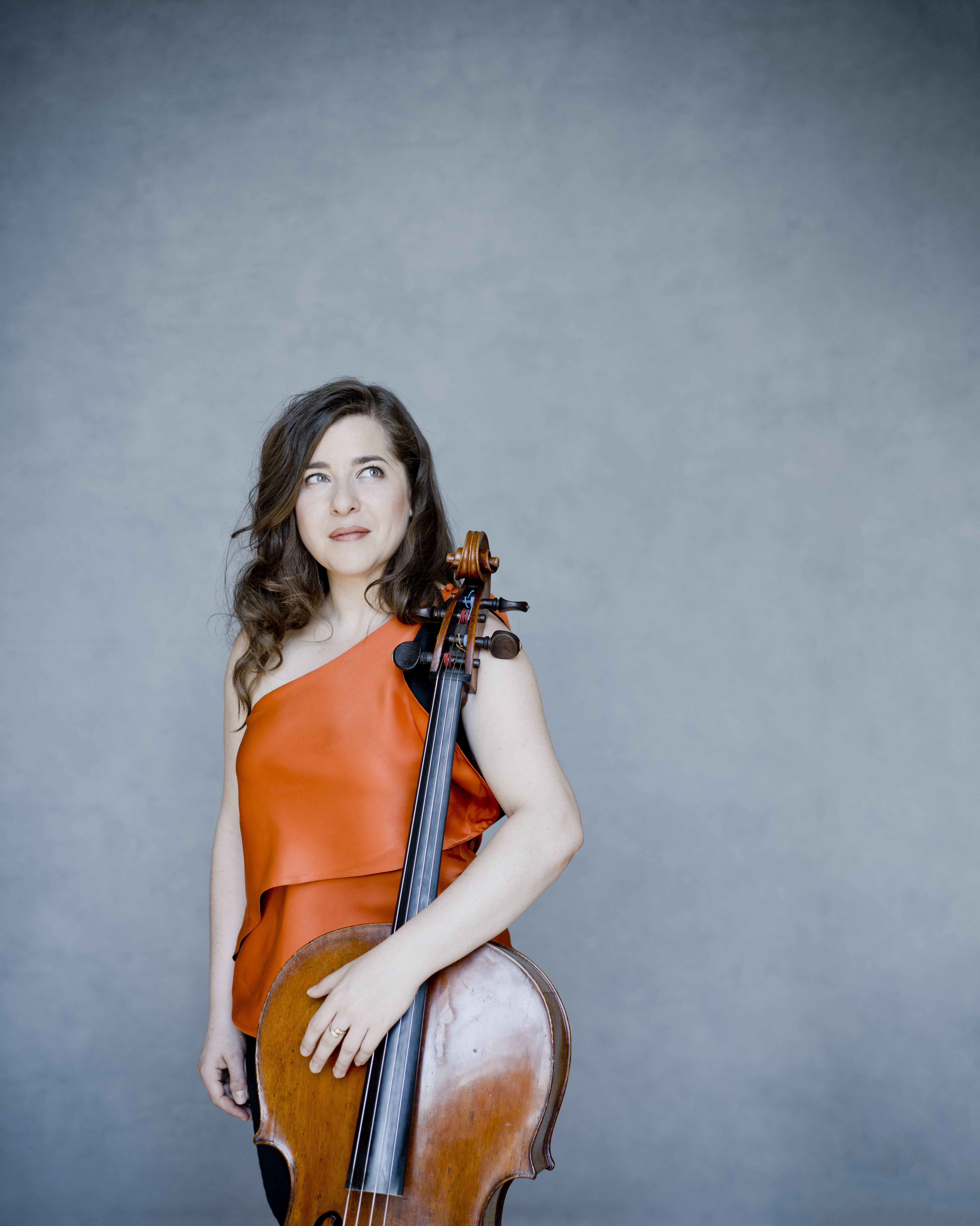
Alisa Weilerstein is one of the foremost cellists of our time. Known for her consummate artistry, emotional investment, and rare interpretive depth, she was recognized with a MacArthur “genius grant” Fellowship in 2011. Today, her career is truly global in scope, taking her to the most prestigious international venues for solo recitals, chamber concerts, and concertos, in collaboration with preeminent composers, conductors, and orchestras worldwide. Dedicated to expanding the cello literature, she is celebrated not only for her authoritative live and recorded interpretations of the core repertoire, but also for bringing new works to life through a wealth of solo and concerto commissions. “Weilerstein is a throwback to an earlier age of classical performers: not content merely to serve as a vessel for the composer’s wishes, she inhabits a piece fully and turns it to her own ends,” marvels the New York Times. “Weilerstein’s cello is her id. She doesn’t give the impression that making music involves will at all. She and the cello seem simply to be one and the same,” agrees the Los Angeles Times. As the UK’s Telegraph puts it, “Weilerstein is truly a phenomenon.”
With her multi-season solo cello project, “FRAGMENTS,” Weilerstein aims to reimagine the concert experience. Comprising six programs, each an hour long, the series sees her weave together the 36 movements of Bach’s solo cello suites with 27 newly commissioned works. Performed in a multisensory production directed by Elkhanah Pulitzer, with responsive lighting and scenic elements, each program offers a fully immersive and visceral listening experience. Since premiering the first two programs at Toronto’s Koerner Hall in early 2023, Weilerstein has performed selected FRAGMENTS at Santa Barbara’s Campbell Hall, San Diego’s Conrad Prebys Performing Arts Center, Cleveland’s Severance Hall, Tanglewood Music Festival’s Seiji Ozawa Hall, Boston’s Sanders Theatre, the Maison symphonique de Montréal, Los Angeles’s Walt Disney Concert Hall, New York’s Carnegie Hall, the Kennedy Center in Washington, D.C., and Charleston’s 2025 Spoleto Festival USA, where her debut account of the complete cycle was hailed as “the most awesome classical-music event this season … , a creation you literally had to see” (Classical Voice North America). Following European, Czech, German, and UK premieres in 2025-26, Weilerstein completes the cycle in Carnegie Hall in 2026–27, as well as giving its first performances in Taiwan and Shanghai and continuing in San Diego with FRAGMENTS 5.
As a champion of contemporary music, commissioning new works for FRAGMENTS is just one of the ways Weilerstein has demonstrated her commitment to expanding the cello repertoire. As well as working extensively with Lera Auerbach, Osvaldo Golijov, and Joseph Hallman, she has premiered important new concertos written for her by six leading contemporary composers: Pascal Dusapin’s Outscape (2016), Matthias Pintscher’s un despertar (2017), Joan Tower’s A New Day (2021), Gabriela Ortiz’s Dzonot (2024), Thomas Larcher’s Returning into Darkness (2025), and Richard Blackford’s Cello Concerto (2025). Following up on the world and European premieres of Larcher’s concerto with the New York Philharmonic and Bavarian Radio Symphony, she returns to the work in 2026–27 to play its Austrian premiere with the Tonkünstler Orchestra.
Weilerstein’s other 2026-27 concert highlights include a residency with the Boston Symphony Orchestra, during which she performs Prokofiev’s Sinfonia Concertante under the baton of Paavo Järvi, and performances of the same work with the Pittsburgh and Chicago Symphony Orchestras. She gives notable performances of Elgar’s Cello Concerto with the City of Birmingham Symphony Orchestra led by her brother Joshua Weilerstein and the San Diego Symphony led by her husband Rafael Payare, before touring the same work with Sir Antonio Pappano leading the London Symphony Orchestra. The tour culminates at Carnegie Hall, where Weilerstein is also joined by Maxim Vengerov and Kirill Gerstein for a performance of Beethoven’s Triple Concerto. Other highlights include the European premiere of Wynton Marsalis’s recent Cello Concerto with the Netherlands Philharmonic; Strauss’s Don Quixote with the Cincinnati Symphony Orchestra under the baton of Cristian Mӑcelaru and the Orchestre symphonique de Montréal led by Payare; and two performances in Helsinki of Shostakovich’s Cello Concerto No. 2 with the Finnish Radio Symphony Orchestra led by Ryan Bancroft. Beyond the symphony hall, she gives recitals with regular piano partner Inon Barnatan in Kansas City, California, and Washington state and solo recitals in Aldeburgh, UK and Abu Dhabi; as well as joining an all-star performance of Brahms’s two string sextets in Carnegie Hall’s “Great Artists” series.
Having given rapturously received live accounts on three continents, Weilerstein is already recognized as one of the leading exponents of Bach’s six suites for unaccompanied cello. A Billboard bestseller, her Pentatone recording of the complete Bach suites was nominated for a 2021 Gramophone Award, while her insights into his first G-major prelude, as captured in Vox’s YouTube series, have been viewed more than 2.3 million times. During the first weeks of the pandemic, she chronicled her developing engagement with the suites on social media, fostering an even closer connection with her online audience in her innovative #36DaysOfBach project.
In 2025–26, Weilerstein released recordings of two concertos written for her: Richard Blackford’s The Recovery of Paradise and Gabriela Ortiz’s Dzonot, on the composer’s Grammy Award-winning album Yanga. In 2024, Weilerstein and Inon Barnatan released a recording of Brahms’s Cello Sonatas on Pentatone, following up on their 2022 recording of Beethoven’s Cello Sonatas, and also recorded Beethoven’s Triple Concerto for a 2019 release with Stefan Jackiw, Alan Gilbert, and London’s Academy of St Martin in the Fields. The previous year, Weilerstein recorded both Haydn cello concertos as Artistic Partner of Norway’s Trondheim Soloists. Earlier releases include the Elgar and Elliott Carter cello concertos with Daniel Barenboim and the Staatskapelle Berlin, named “Recording of the Year 2013” by BBC Music; Dvořák’s cello concerto with the Czech Philharmonic, which topped the U.S. classical chart; and her 2016 recording of Shostakovich’s cello concertos with the Bavarian Radio Symphony and Pablo Heras-Casado, which proved “powerful and even mesmerizing” (San Francisco Chronicle). She and Barnatan made their duo album debut with sonatas by Chopin and Rachmaninoff in 2015, a year after she released Solo, a compilation of unaccompanied 20th-century cello music that was hailed as an “uncompromising and pertinent portrait of the cello repertoire of our time” (ResMusica, France). Solo’s centerpiece is Kodály’s Sonata for Solo Cello, a signature work that Weilerstein revisits on the soundtrack of If I Stay, a 2014 feature film starring Chloë Grace Moretz in which the cellist makes a cameo appearance as herself.
Weilerstein has appeared with all the major orchestras of the United States, Europe, and Asia, collaborating with conductors including Marin Alsop, Daniel Barenboim, Jiří Bělohlávek, Semyon Bychkov, Thomas Dausgaard, Sir Andrew Davis, Gustavo Dudamel, Sir Mark Elder, Edward Gardner, Alan Gilbert, Giancarlo Guerrero, Bernard Haitink, Pablo Heras-Casado, Marek Janowski, Lorin Maazel, Zubin Mehta, Ludovic Morlot, Yannick Nézet-Séguin, Peter Oundjian, Donald Runnicles, Yuri Temirkanov, Michael Tilson Thomas, Osmo Vänskä, Simone Young, and David Zinman. In 2009, she was one of four artists invited by Michelle Obama to participate in a widely celebrated and high-profile classical music event at the White House, featuring student workshops hosted by the First Lady and performances in front of an audience that included President Obama and the First Family. A month later, Weilerstein toured Venezuela as soloist with the Simón Bolívar Symphony Orchestra under Dudamel and has since made numerous return visits to teach and perform with the orchestra as part of its famed El Sistema music education program.
Born in 1982, Alisa Weilerstein discovered her love for the cello at just two and a half, when she had chicken pox and her grandmother assembled a makeshift set of instruments from cereal boxes to entertain her. Although immediately drawn to the Rice Krispies box cello, Weilerstein soon grew frustrated that it didn’t produce any sound. After persuading her parents to buy her a real cello at the age of four, she developed a natural affinity for the instrument and gave her first public performance six months later. In 1995, at 13, she made her professional concert debut, playing Tchaikovsky’s “Rococo” Variations with The Cleveland Orchestra, and in March 1997 she made her first Carnegie Hall appearance with the New York Youth Symphony. A graduate of the Young Artist Program at the Cleveland Institute of Music, where she studied with Richard Weiss, Weilerstein also holds a degree in history from Columbia University. She was diagnosed with type 1 diabetes (T1D) at nine years old, and is a staunch advocate for the T1D community, serving as a consultant for the biotechnology company eGenesis and as a Celebrity Ambassador for Breakthrough T1D (formerly JDRF), the world leader in T1D research. Born into a musical family, she is the daughter of violinist Donald Weilerstein and pianist Vivian Hornik Weilerstein, and the sister of conductor Joshua Weilerstein. She is married to conductor Rafael Payare, with whom she has two young children.